
Hammond Epoxy Flooring installs commercial kitchen flooring in Hammond, IN, serving surrounding cities including Griffith, Riverdale, Harvey, Dyer and Homewood. A kitchen floor takes boiling water, hot oil, grease, steam cleaning and harsh sanitizers every day, then gets looked at closely by a health inspector. After more than 20 years on concrete, we build kitchen floors to handle both.
Most of our kitchen work uses urethane cement, a resin system designed for hot, wet and greasy conditions, with an integral cove base that runs up the wall so there is no seam for water and grime. Dry storage and back rooms can use epoxy. The proposal names the system for each zone, the product line, the thickness, the slope to drains and the closure plan.
We work in restaurants, bakeries, school and institutional kitchens, catering kitchens, food halls and back-of-house kitchens at hotels and casinos. Each one is phased around service, because a kitchen that closes for a week loses more than the floor costs.
Health Code and Kitchen Floors
Smooth, Durable and Easily Cleanable
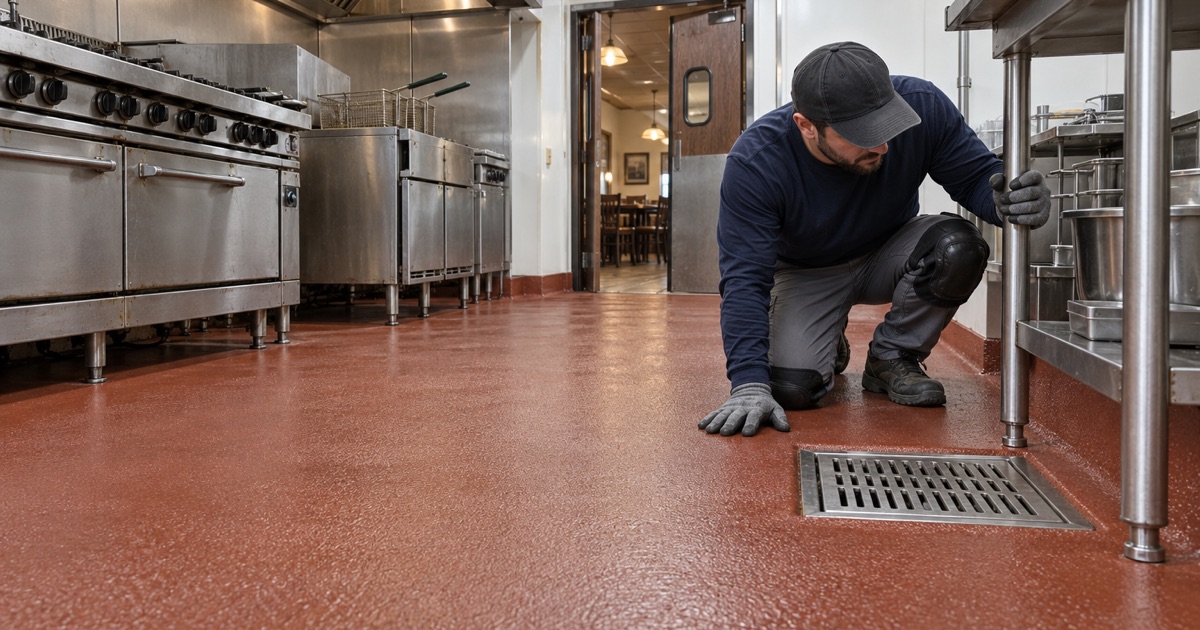
The FDA Food Code, adopted by state and local health departments, requires floors in food preparation, storage and warewashing areas to be smooth, durable and easily cleanable, and nonabsorbent where they get wet. Section 6-201.11 also allows antislip floor treatments for safety, which is how a textured kitchen floor can still meet the rule.
A seamless resin floor answers both needs: it has no grout lines to absorb grease, and its texture can be set for grip without leaving pockets that trap food soil.
Coved Junctures at the Wall
Section 6-201.13 of the Food Code calls for the junctures between floors and walls to be coved and sealed in areas cleaned by water flushing. We trowel an integral cove base up the wall as part of the floor, so the floor and base are one continuous surface with no seam where they meet.
That corner is often one of the first places an inspector looks, because a cracked tile base or gapped cove collects water, grease and pests.
Inspections and New Establishments
In Lake County, Indiana, new food establishments must receive a pre-inspection from the Lake County Health Department before operating, and other jurisdictions set their own process. We schedule kitchen floor work so it is cured and clean well before any inspection date, and we can provide product data sheets when an inspector asks for them.
Building a Floor for Heat, Grease and Water
Urethane Cement Systems
Urethane cement combines a polyurethane resin with cement and aggregate. It tolerates thermal shock from hot water and steam, resists fats, oils and many food acids, and holds up to heavy carts and dropped pans. It is applied as a troweled mortar or a self-leveling slurry, often with a broadcast for grip.
Urethane cement is also more tolerant of damp concrete than most epoxies, which helps on older slabs, although we still test and repair the substrate before installing it.
Slope, Drains and Grease Interceptors
Water has to leave a kitchen floor quickly. We build or correct the slope to floor drains and trench drains and terminate the system cleanly at each drain body. Ponding water around a dish machine or a kettle is a slip hazard and an inspection problem, so we check the fall before and after install.
Grease interceptors, cleanouts and their lids stay accessible and serviceable. The floor around them is built to take the pumping and cleaning they need without lifting at the edges.
Walk-Ins, Freezers and Cooking Lines
Walk-in coolers and freezers move through cold temperatures and frequent door openings, while cooking lines see heat, grease and dropped utensils. We choose the system and thickness for each, detail the transition at the walk-in door, and plan installs in freezers around the time needed to bring them back down to temperature.
Planning a Kitchen Floor Project
Removing Tile and Preparing the Slab
Many kitchens have quarry tile or failing vinyl over a slab that has absorbed years of grease. Loose tile, cracked grout and grease-saturated concrete are removed, and the slab is shot blasted or ground until it is clean and sound. Spalls and low areas are rebuilt and the slope is corrected before the new system goes down.
Where existing quarry tile is sound and well bonded, some systems can go over it after grinding. We test it first and explain which route will last.
Phasing Around Service
We work closely with the kitchen manager to plan equipment moves, closures and phasing. Many kitchens are done over a few nights or a short planned closure, using fast-cure systems so each zone returns to service on time. Grinding dust is captured at the machine and never washed into floor drains.
Odor and timing matter in a food business. We schedule the strongest-smelling steps when no food is being prepared, protect stored food and supplies, and ventilate before staff return, so the kitchen reopens to a cured, clean floor rather than a fresh coat still giving off fumes.
Cleaning and Long-Term Care
A resin kitchen floor is cleaned with the same daily routine as any commercial kitchen, using a deck brush or scrubber and a degreaser suited to the system. We leave cleaning guidance with the staff and recommend inspecting the cove and drain edges periodically, because small repairs there keep a kitchen floor sound for years.
The most common cause of damage after installation is not cooking but equipment. Dragging a range or a loaded rack across the floor, or dropping a heavy pot from height, can gouge any surface. Casters, glides and a plan for moving heavy equipment protect the floor as much as the cleaning routine does.
- 20+ Years on Concrete
- Moisture Test in Every Scope
- Free Written Estimates