
Hammond Epoxy Flooring installs flake epoxy floors in Hammond, IN, serving surrounding cities including Griffith, Riverdale, Harvey, Dyer and Homewood. A flake floor, also called a chip or broadcast floor, is the system most homeowners picture when they think of a coated garage, and after more than 20 years on concrete we know it earns that place: it hides wear, adds grip and holds up through a Lake County winter when it is built properly.
Built properly means the slab comes first. We diamond grind to a measured profile, repair cracks and spalls, and test for moisture before pricing. The proposal names the base coat, the flake blend and size, the broadcast rate, the topcoat, the coat count and the finished thickness, so the floor in your garage can be checked against it.
Flake floors suit garages, basements, mudrooms, workshops, locker rooms, showrooms and many commercial back-of-house spaces. We help you choose the chip size, color blend and topcoat for the room rather than defaulting to one look for every floor.
How a Flake Floor Is Built
The Base Coat
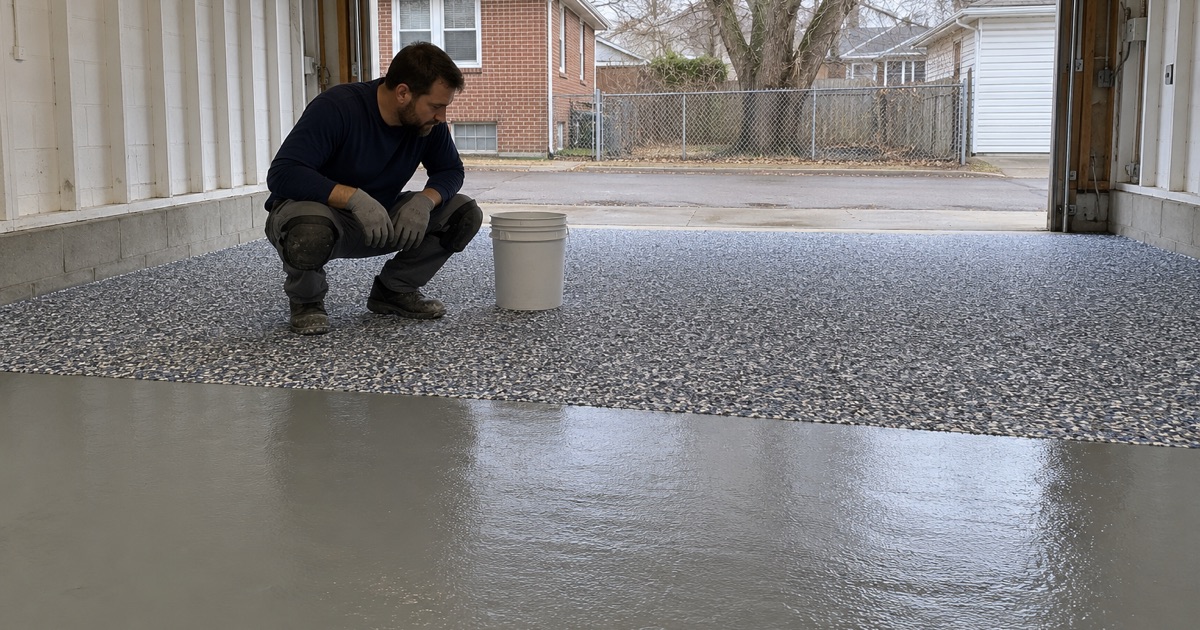
The base coat bonds the system to the ground slab and holds the flake. We use a 100% solids or high-build epoxy, tinted to complement the flake blend, at a thickness that will lock the chips in place. A thin base lets chips sit loose and shed, which shows as bare spots after scraping.
On a slab that tests high for moisture vapor, a moisture-mitigation primer goes down before the base. That decision comes from the reading, and the proposal says which primer is used.
Full or Partial Broadcast
While the base is wet, vinyl flake is thrown by hand across the floor. A full broadcast to rejection keeps adding chips until the base will take no more and no base color shows, which gives an even, dense look and a thicker floor. A partial broadcast scatters chips over a visible base color for a lighter pattern and lower media cost.
Most garages get a full broadcast, because it hides more slab flaws, disguises dirt and salt residue better and gives more texture underfoot.
Scraping and the Clear Topcoat
Once the base cures, loose chips are swept up and the floor is scraped to knock down sharp edges and high points. Then a clear topcoat seals the flake. We use polyaspartic or aliphatic polyurethane topcoats, which resist abrasion and road salt and do not yellow in sunlight the way plain epoxy does near an open garage door.
The topcoat thickness and texture set how smooth the floor feels. One heavy topcoat gives a smoother, easier-to-clean surface; a lighter coat leaves more of the chip texture for grip.
Choosing Flake Size and Color Blend
Chip Size
Flake comes in sizes from fine to large. Small chips give a tight, granite-like speckle and a smoother feel, medium chips are the common garage choice, and large chips give a bold pattern with more texture. Chip size also affects how much topcoat is needed to fully seal the surface.
In a basement or showroom, smaller chips often look more refined. In a working garage, medium chips balance looks, grip and how well they hide tire marks.
Color Blends
Blends mix several chip colors, from grays and tans that suit most homes to bolder mixes with black, white, blue or red. Gray-heavy blends hide road grime and salt residue well, and tan and brown blends hide dirt in workshops. Very dark blends show dust and lint; very light ones show tire marks.
We bring sample boards so you can see blends under your own lighting, since garage lighting can change how a blend reads compared with a brochure.
Matching the Look to the Room
A garage, a basement family room and a commercial locker room each call for a different combination of chip size, blend and topcoat sheen. We ask how the room is used, how it is lit and what tracks across it before recommending a combination, so the floor works in its space, not just on a sample board.
Grip, Texture and Wear
Slip Resistance
A flake floor is textured, but a heavy topcoat can make it smooth enough to be slick under slush or water. We specify grip by the broadcast and topcoat: a lighter topcoat over a full broadcast, or an anti-slip additive in the topcoat, for garages, mudrooms and locker rooms that see wet traffic.
There is a tradeoff with cleaning. More texture gives more grip but holds more dirt, so we match the texture to how wet the floor gets and how it will be cleaned.
Salt, Brine and Winter Traffic
From December to March, tires bring brine and rock salt into every garage. A flake floor with a chemical-resistant topcoat keeps the salt on the surface, where it can be squeegeed out, and the speckle hides dried residue between rinses. Bare concrete absorbs that salt and scales.
We still recommend rinsing the floor a few times during the season, because salt film left for months dulls even a good topcoat.
Hot Tires and Dropped Tools
A properly built flake floor resists hot tire pickup because the base is thick, bonded to a ground profile and topped with a hard, fully cured coat. The chips also help absorb small impacts from dropped tools, and minor chips in a flake floor are much less noticeable than on a solid color or metallic finish.
- 20+ Years on Concrete
- Moisture Test in Every Scope
- Free Written Estimates