
Hammond Epoxy Flooring handles concrete floor repair in Hammond, IN, serving surrounding cities including Griffith, Riverdale, Harvey, Dyer and Homewood. Every coating we install sits on a repaired slab, and over more than 20 years on concrete we have learned that most coating failures blamed on the product were really repairs that were skipped or rushed.
Before we price a floor, we map every crack, spall, pit, old patch and joint. Each one is listed in the scope with the repair it needs. When the slab is heaving, sinking or broken badly enough that a repair will not hold, we say so in writing and recommend replacement first, rather than coating over a floor that is still moving.
We repair garage floors, basements, shop and warehouse slabs and plant floors, with or without a coating to follow. The repair material is chosen for the traffic, the exposure and whatever goes on top.
Cracks: Reading Them Before Filling Them
Shrinkage and Hairline Cracks
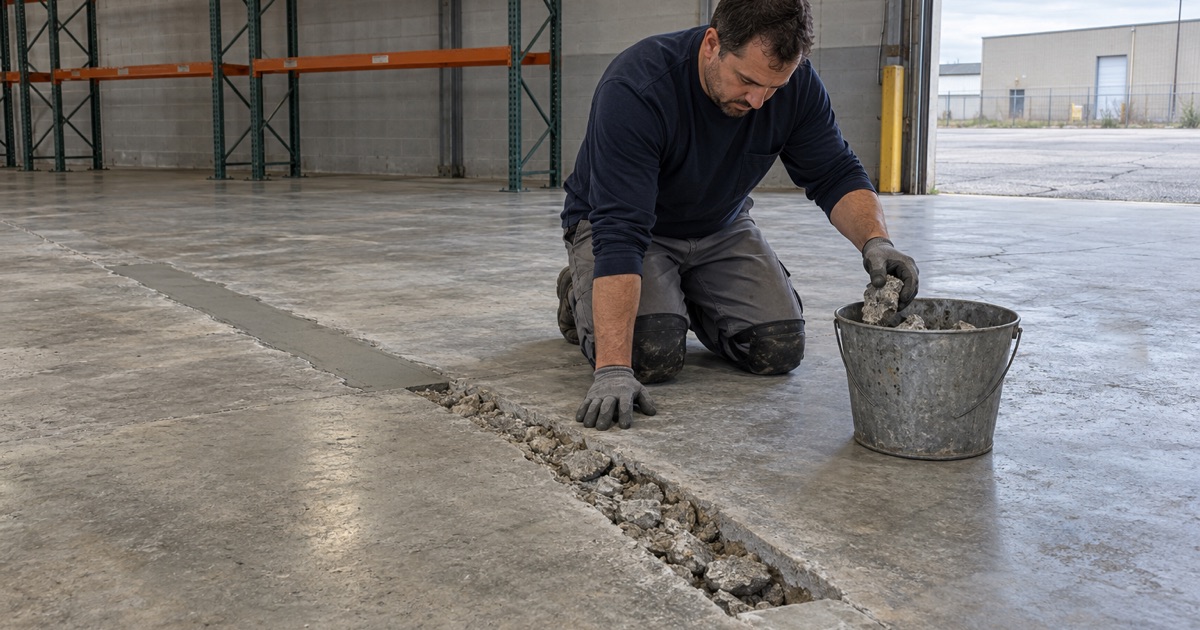
Most slabs crack as they cure and shrink, and those cracks are usually stable. We open them with a crack-chasing blade or grinder so the repair material can get in, clean out the dust, fill them with an epoxy or polyurea crack filler and grind them flush. Under a broadcast coating they disappear.
A crack that has not grown in years and has no offset across it is the easy kind. Those make up most of what we see in garages and basements.
Moving and Offset Cracks
A crack that is widening, that has one side higher than the other or that keeps reopening is moving. Filling it rigidly just moves the crack next to the repair, and coating over it puts a line through the new floor. These cracks tell us something about what is under the slab.
In parts of north Hammond, slabs sit on fill that includes old steel-mill slag, which can expand as it hydrates and has been known to lift floors. Elsewhere, sandy ground and poor compaction let slabs settle. We look at a moving crack as a question about the ground first and the coating second.
Leaking Cracks in Basements
A basement crack that seeps water during storms is not just a surface flaw. It points to water pressure under or beside the slab. We do not seal those and call the basement dry; the water source needs drainage, a sump system or foundation work before a floor coating makes sense.
Spalls, Pitting and Salt Damage
Spalled Edges and Joints
Spalling is concrete breaking away at edges, joints and corners, often where forklift wheels, cars or dropped loads hit hardest. We cut out loose material back to sound concrete, prime the edges and rebuild them with a fast-setting repair mortar or an epoxy mortar, then grind them flush with the surrounding slab.
On warehouse and plant floors, rebuilt joint edges keep pallet jack and forklift wheels from chipping the slab further and from chipping a new coating at the joint line.
Salt Scaling and Pitting
From December to March, tires carry brine and rock salt into every garage and loading dock in the region. Repeated freezing and thawing with salt in the pores flakes off the surface and leaves pits, usually worst at the parking spots and the apron. We grind away the scaled layer, fill pits and resurface where needed.
On an older garage slab that has taken decades of winters, scaling can be deep enough that a full skim coat is the cleanest repair before coating.
Popouts and Surface Voids
Popouts are small conical holes left when a piece of aggregate near the surface breaks free. Bug holes and voids appear on vertical faces and poorly finished slabs. Each is filled and ground flat so the coating does not pinhole over it or show a dimple in the finish.
Voids matter more under thin systems. A polyaspartic topcoat or a solid color epoxy will outline every small hole as the coating sinks into it, while a full flake broadcast hides more. We fill to suit the system in the proposal, so the surface is ready for the coating that will actually go on it.
Old Patches, Overlays and Leveling
Failed Patches
Older floors often carry patches made with the wrong material, feathered too thin or never bonded properly. They sound hollow when tapped and break under grinding. We remove them back to sound concrete and rebuild them with a material compatible with the coating that will go over them.
Much of Hammond’s housing predates 1980, and close to a third predates 1940, so we see layers of patching on many basement and garage floors. Each one is checked rather than assumed sound.
Low Spots and Uneven Floors
Grinding takes down high spots, but low areas have to be filled. Shallow dips can be leveled with an epoxy mortar or patching compound; larger areas may need a self-leveling underlayment. Flatness matters most for metallic and polished floors, where every ridge and hollow shows under light.
Slope is part of the same conversation. Garage floors pitch toward the door and basement floors toward a drain, and a leveling repair must keep that pitch so water still runs off. We check the fall before filling any low spot near a door or drain.
When Replacement Beats Repair
If a slab has heaved, sunk significantly, cracked into separate pieces or is crumbling across large areas, patching becomes a recurring cost rather than a fix. We tell you that before quoting, and we can point you toward slab replacement first, because coating a failing slab only adds cost to work that will be torn out anyway.
- 20+ Years on Concrete
- Moisture Test in Every Scope
- Free Written Estimates