
Hammond Epoxy Flooring installs polyaspartic floor coating systems in Hammond, IN, serving surrounding cities including Griffith, Riverdale, Harvey, Dyer and Homewood. Polyaspartic is the fast-curing, UV-stable member of the polyurea family, and over more than 20 years on concrete we have learned where it earns its higher material cost and where an epoxy base still does the heavy lifting.
The chemistry is fast, but the preparation is not. Every slab is still diamond ground to a measured profile, every crack and spall is mapped and repaired, and the moisture test goes into the scope before the price is final. Your proposal lists each layer of the system, the product line, the coat count and the finished thickness.
Most of our polyaspartic work is a topcoat over an epoxy base with a flake or quartz broadcast, which pairs the deep bond and build of epoxy with the wear and color stability of polyaspartic. On some floors, a full polyaspartic system makes sense, and we explain why when it does.
What Makes Polyaspartic Different
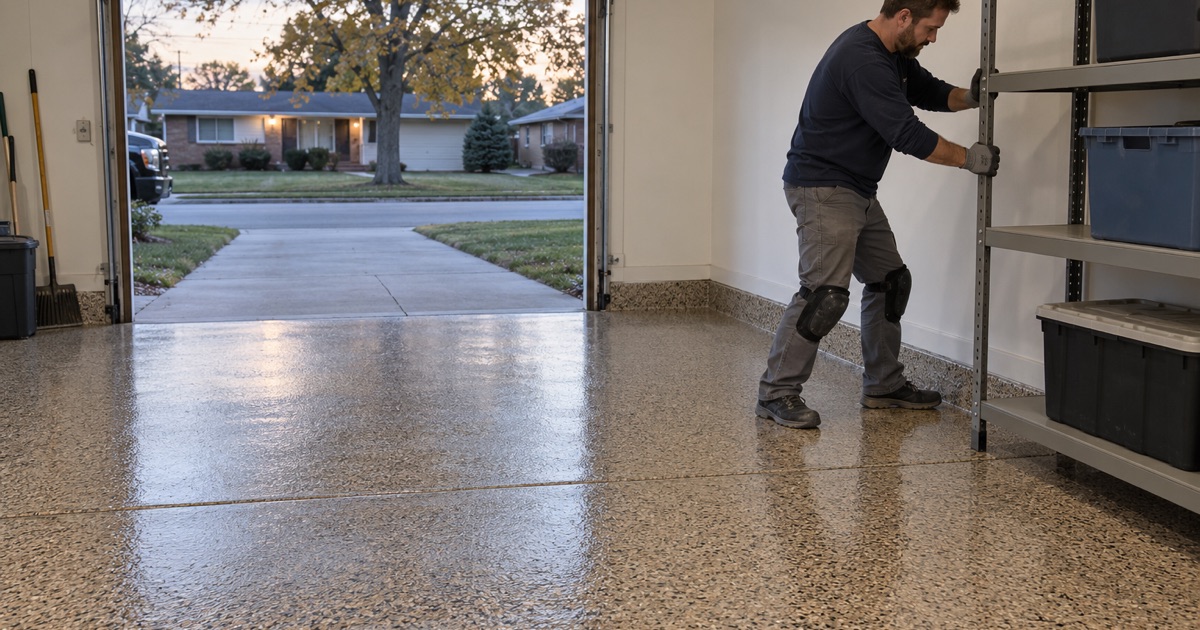
Aliphatic Chemistry and UV Stability
Standard epoxy is aromatic, and ultraviolet light turns it amber over time. Polyaspartic is aliphatic, so it keeps its color and clarity in sunlight. That matters at a garage door that stays open on summer afternoons, at a storefront entry or in a showroom with large windows.
We use a polyaspartic topcoat anywhere the floor sees daylight, because yellowing is permanent once it starts and cannot be cleaned off.
Fast Cure and Short Working Time
Polyaspartic cures in a fraction of the time epoxy needs, which shortens the install and gets a floor back in service sooner. The same speed gives the installer a short working window, so mixing, spreading and back-rolling have to be tightly organized.
A rushed or poorly mixed batch shows as roller marks, bubbles or soft spots. We mix in measured batches sized to the area a crew can finish within the product’s pot life, rather than pouring out more than can be spread cleanly.
Part of the Polyurea Family
Polyaspartic is a modified polyurea, designed to slow pure polyurea’s near-instant cure to something that can be rolled on a floor. That is why it is often called a polyurea coating in sales material. On a proposal we name the actual product line, so you know exactly what is going down.
Products sold under the same label vary widely in solids content, recommended film thickness and cure speed. Naming the product and the coat count in writing lets you compare two quotes on what they actually contain rather than on the word polyaspartic printed on both.
Polyaspartic Compared With Epoxy
Bond and Film Build
Epoxy is still the stronger choice for the first coat on most slabs. A 100% solids epoxy base penetrates the ground profile, bonds deeply and builds thickness in one pass, which helps it bridge minor surface flaws. Polyaspartic goes on thinner per coat and relies on a perfectly prepared surface.
That is why our standard garage system uses an epoxy base and a polyaspartic topcoat: each layer does the job its chemistry suits best.
One-Day Floors, Honestly
Some contractors sell one-day polyaspartic floors as a feature. The speed is real, but only on a slab that grinds clean, needs little repair and tests dry. A floor with deep spalls, old coatings or a high moisture reading needs more time no matter what goes on top.
We would rather take a second day than lay a fast coating over a slab that was not ready. The proposal states the schedule, and the schedule follows the slab.
Abrasion, Salt and Hot Tires
Polyaspartic topcoats stand up well to abrasion, gasoline and oil drips, and the brine and rock salt that tires carry in from December to March. They also resist hot tire pickup when applied over a well-bonded base, because the topcoat is hard and fully cured before a warm tire ever sits on it.
In a garage or a fleet bay, that means the wheel paths keep their finish through salt season rather than dulling and wearing through by spring.
Where Polyaspartic Floors Work Best
Residential Garages and Mudrooms
For a home garage, polyaspartic over an epoxy base with a full flake broadcast is our most common system. It handles salt, hot tires and dropped tools, keeps its color at the door and goes back into use quickly. The same build works in mudrooms and entry areas where wet boots come in all winter.
Where an attached garage shares a wall with the house, the shorter cure also shortens the time the family has to work around the job.
Commercial Entries and Showrooms
Storefronts, lobbies and showrooms with big windows need a floor that will not yellow in sunlight and can be cleaned constantly. A polyaspartic topcoat over a decorative flake or metallic base gives that, and fast cure keeps closures short.
For a business that cannot close, we can phase a floor in sections overnight so each zone is ready for the next morning.
Fleet Bays and Back-of-House
Fleet and truck bays, casino and hotel back-of-house corridors and loading areas run around the clock. The fast cure of polyaspartic lets us coat a zone overnight and return it to service by the next shift, with a broadcast built in for grip where liquids and slush reach the floor.
In a truck or rail shop, hot tires, coolant and oil drips and winter brine all land on the same few bays. We pair a chemical-resistant polyaspartic topcoat with repaired joints and a quartz or flake broadcast, and phase the bays so the shop keeps working while each one cures.
Installing Polyaspartic in Northwest Indiana Conditions
Dew Point and Slab Temperature
Polyaspartic tolerates lower temperatures than epoxy, but no coating likes a damp surface. If the slab sits too close to the dew point, moisture condenses on it and ruins adhesion. We measure slab temperature and dew point spread before each coat rather than going by the calendar or the air temperature alone.
The NOAA 1991-2020 normals at Chicago Midway count about 106 days a year with a low at or below freezing, and an unheated detached garage can hold a cold slab long after the air warms up. When a slab cannot hold a safe margin through the cure, we book the job for warmer weather rather than gamble on it.
Humidity and Bubbling
High humidity speeds the cure of many polyaspartic products even further and can cause bubbling or a shortened working time on a muggy summer day. We adjust batch sizes and crew sequence to the conditions, and on extreme days we reschedule rather than fight the chemistry.
Air movement matters as well. Fans blowing across a fresh coat can skin the surface and trap solvent or air underneath, so we control ventilation during application and open the space up once the coat has set, which also clears odor sooner in an attached garage.
Moisture Testing Before the Topcoat Choice
A fast topcoat does nothing to stop vapor coming up through the slab. We test with an ASTM F1869 calcium chloride kit or ASTM F2170 relative humidity probes, and the result decides the base and primer. The proposal names the test and the reading the floor must meet before anything is applied.
This matters for warranty as well as performance. Most coating warranties exclude failures caused by moisture vapor or hydrostatic pressure, so we read that exclusion out before you sign. A floor that tests high gets a moisture-mitigation primer or a different plan, never a quick topcoat and a hope.
- 20+ Years on Concrete
- Moisture Test in Every Scope
- Free Written Estimates