
Hammond Epoxy Flooring grinds and finishes polished concrete floors in Hammond, IN, serving surrounding cities including Griffith, Riverdale, Harvey, Dyer and Homewood. After more than 20 years working on concrete, we know that polishing is not a coating: it is the slab itself, ground flat, hardened and refined until it reflects light.
That makes the slab you start with the biggest factor in the result. Before we price a polished floor, we walk it, map cracks, patches and old coatings, and test-grind a small area so you can see the aggregate and color your concrete will show. A slab that should be repaired first, or one better suited to a coating, is called out at that stage.
Polished concrete suits warehouses, retail floors, offices, showrooms and finished basements. It is dust-free once densified, easy to maintain, and has no film to peel, which is why so many commercial owners choose it for floors that take forklifts and foot traffic all day.
How Concrete Polishing Works
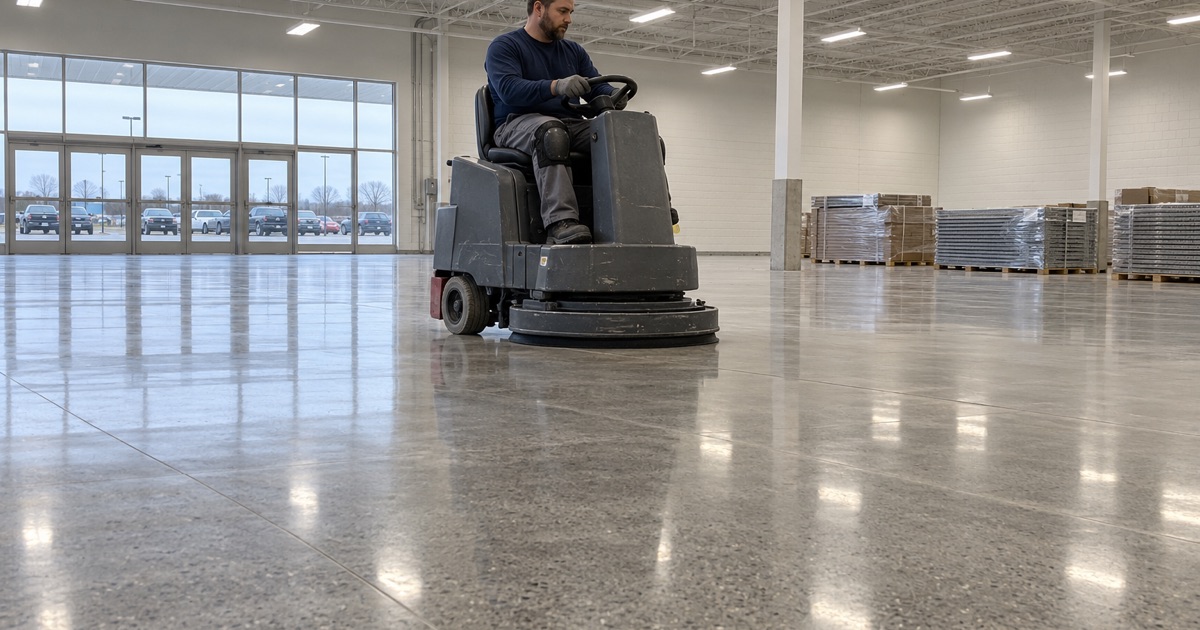
Diamond Grinding to a Flat, Open Surface
Polishing starts with coarse metal-bond diamonds that remove old sealers, coatings, adhesives and the weak top layer of the slab. Each pass uses a finer grit to remove the scratches of the one before. This stage sets how flat the floor will be and how much aggregate the finish exposes, so it gets the most time.
We grind with vacuums running at the machine, so dust is collected as it is made. That keeps a plant, a store or a home livable during the work and keeps fines out of floor drains and storm inlets.
Lithium Silicate Densifier
Once the surface is open, a lithium silicate densifier is applied. It reacts with the free lime in the concrete to form a harder, denser surface that resists dusting and wear and polishes to a higher shine. Lithium products penetrate well and dry without the residue older sodium silicate densifiers could leave.
The densifier is what turns a ground slab into a durable wearing surface. Without it, a polished floor can dust under traffic and lose its finish in the busiest lanes.
Resin-Bond Polishing and the Final Guard
After densifying, resin-bond diamonds refine the surface through progressively finer grits until it reaches the chosen gloss. A penetrating guard or stain-resistant treatment can then be burnished in to help resist spills such as oil and coffee, without forming a film that would scratch or peel.
The final grit sets the gloss level. A lower grit gives a satin or matte look that hides scuffs, and a higher grit gives a mirror-like reflection suited to showrooms and lobbies.
Grind Levels and Finished Looks
Cream Finish
A cream finish removes only the very top of the slab, leaving the smooth paste layer with little or no aggregate showing. It gives a uniform, modern look and the least grinding time. It also shows any trowel marks, patches and blemishes in the original pour, so it works best on a slab that was finished well.
Cream finishes are most often chosen for newer slabs that were poured and troweled with polishing in mind. On an older floor that has been patched, scraped and stained over the years, the paste layer usually carries too much history for a cream finish to read as uniform.
Salt-and-Pepper Finish
A slightly deeper grind exposes the fine sand in the mix, giving a speckled salt-and-pepper look. It hides small surface flaws better than a cream finish and is a common choice for retail and office floors. The test grind shows how evenly your slab exposes that fine aggregate.
Because the grind goes a little deeper than a cream finish, shallow scratches, light staining and minor trowel marks are often removed along the way. That makes salt-and-pepper a forgiving middle ground for slabs that are sound but not pristine, and it keeps grinding time well below a full aggregate floor.
Full Aggregate Exposure
The deepest grind cuts into the coarse stone in the mix and exposes it across the floor, like a terrazzo look made from your own concrete. It takes the most grinding and reveals whatever stone the original mix used, so the test grind matters most here. Patches and repairs show clearly at this depth.
The stone in a slab is whatever the ready-mix supplier used when it was poured, so two floors in the same neighborhood can look completely different once exposed. Some reveal an even scatter of small gray and tan stone; others show larger, irregular pieces. We grind a sample spot and let you decide before the full floor goes that deep.
Commercial Polished Concrete Floors
Warehouses and Distribution Centers
Forklift and pallet jack wheel loads grind at a floor all day, and a densified polished slab stands up well to that traffic with no coating to scuff or chip. Joints and spalls are repaired first so wheels do not break down the edges. We map the heaviest traffic lanes and loading areas before setting the grind plan.
Polished floors also reflect light, which helps in large buildings, and are cleaned with a standard auto-scrubber. For a warehouse that needs aisle striping, we can lay out lines on the polished surface.
Retail, Showroom and Office Floors
In a store, showroom or office, polished concrete offers a clean modern look that holds up to constant foot traffic. A salt-and-pepper or aggregate finish hides scuffs well, and the gloss can be matched to the space. We phase work around business hours where a space cannot close.
Entry areas need extra thought in this climate. Winter slush, brine and grit tracked in at the door are the fastest way to dull a polished finish and make it slick, so we plan walk-off mats and a cleaning routine for the first twenty feet inside the door as part of the floor, not as an afterthought.
Plants and Food Facilities
Polished concrete can work in dry production and storage areas of a plant, but it is not the right floor for wash-down rooms, wet processing or areas exposed to acids, sugars and fats, which can etch the surface. In those zones we recommend urethane cement or a resin system, and we mark the boundary clearly in the scope.
Hammond’s large food and consumer-goods plants often combine both kinds of space under one roof: dry warehousing and packaging next to wet processing. Splitting the floor by exposure, polished where it stays dry and resin where it is washed, usually gives the plant a better floor at a lower total cost than one system everywhere.
Residential Polished Concrete Floors
Finished Basements
A basement slab can be polished into a durable finished floor, often with area rugs over it in living spaces. Because polished concrete has no film, vapor moving through the slab does not lift it the way it can lift a coating. Efflorescence and dampness still show, so we check the slab and its drainage first.
Older basement floors often carry paint, mastic or patching that must be ground off, and repairs show in the finish. The test grind tells you what to expect before you commit.
Older Slabs and Patches
Much of Hammond’s housing stock predates 1980, and its concrete reflects decades of patches and repairs. Polishing reveals that history rather than hiding it, which some owners love and others do not. Where a uniform look matters more, a coating or overlay is often the better choice, and we say so.
Cracks deserve the same honesty. A stable crack can be filled with a color-matched repair material and polished through, while a crack that is still moving will reopen. In parts of north Hammond built over old slag fill, slabs can lift as the fill expands, so we read any fresh or offset crack before planning a polished floor over it.
Garages and Salt
Polished concrete is not our usual recommendation for a garage here. Brine and rock salt from winter roads sit on the slab, and without a resin layer the salt water reaches the concrete surface. For most garages, a coating system protects the slab better through a Lake County winter.
- 20+ Years on Concrete
- Moisture Test in Every Scope
- Free Written Estimates